FIELD JOURNALFabric evidence
Carpet beetle shed skins: record the object before counting pests
Understand why an empty larval skin can be useful evidence without revealing how many live insects remain.
IN BRIEF
An empty larval skin can support identification and help locate a relevant area. It cannot tell you how many live insects remain or when it was shed from a casual photo.
.jpg)
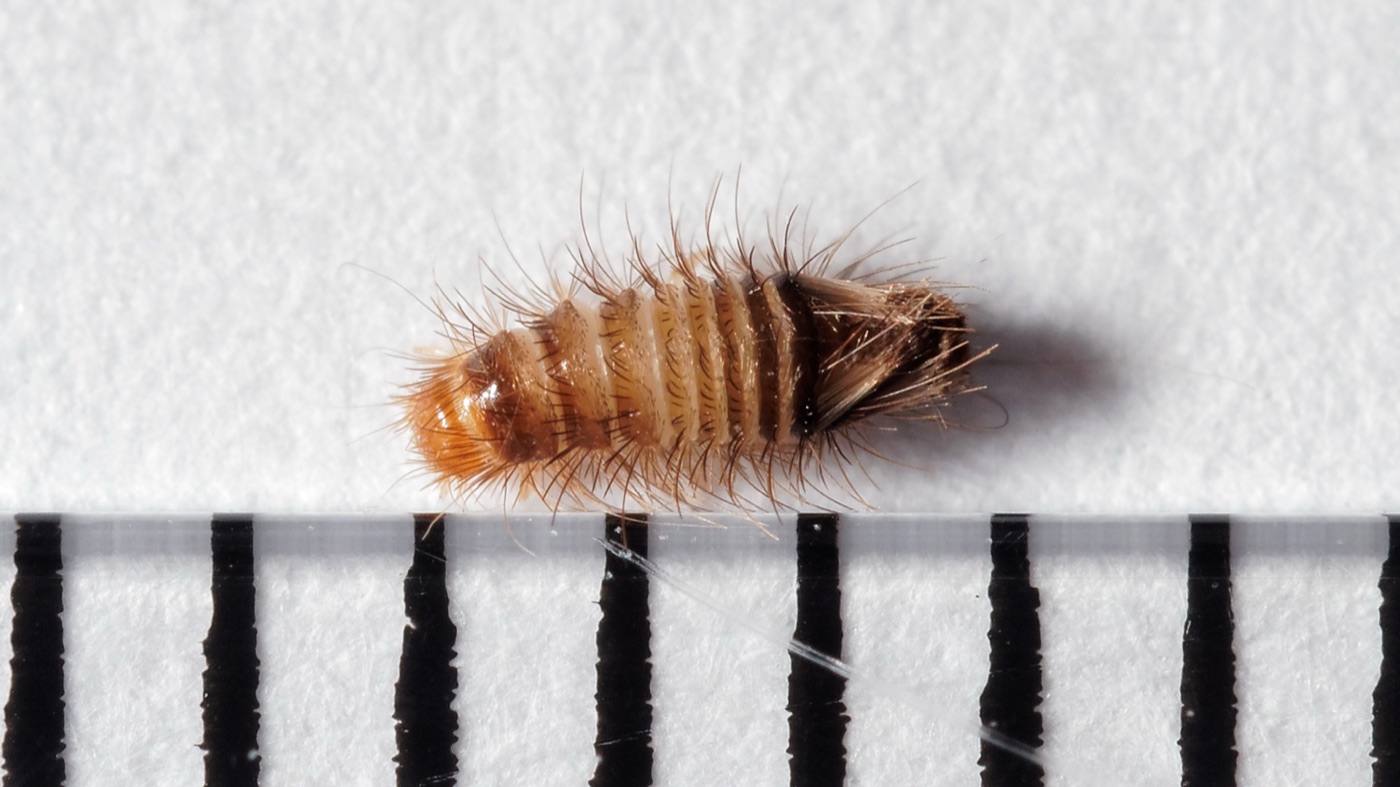
A bristly object may be a live carpet beetle larva or an empty skin left during growth. Both can help an identifier, but they answer different questions. A collection of skins does not provide a reliable count of the insects currently present.
Keep the material context
Record whether the object was on a garment, under a rug edge, near stored natural-fiber material, or on an unrelated surface. If fabric damage is present, photograph it separately and label the item. The position of a skin can guide a check, but it does not prove which nearby item was fed upon.
If you also found an adult beetle, keep a separate photograph. The adult’s appearance should not be used as the visual template for identifying a larval skin.
Compare the condition of the object
Use these descriptions in an identification request rather than deciding from color alone.
| Observation | Useful wording | Conclusion to leave open |
|---|---|---|
| A hollow-looking bristly shell | “Skin-like object; appears empty in photo” | Whether it is a carpet beetle skin |
| An intact bristly body with observed movement | “Moving larva-like insect” | Species until the features are assessed |
| A flattened or broken fragment | “Fragment with hairs; body incomplete” | Life stage and origin |
| Several objects beside a fabric item | “Objects found next to item C2” | Whether that item was the food source |
UC IPM describes shed skins among carpet beetle evidence. It also notes that carpet beetle larvae do not produce the webbing associated with clothes moths. Record webbing as a separate clue if it is present; do not remove it from the account simply because it complicates the first identification.
Establish a baseline before a later comparison
Take an overview that shows the distribution. If an identifier asks for a specimen, use their collection instructions. Keep the image filename, item label and date together. A photograph can document several objects without requiring you to touch or sort every one.
After appropriate identification and cleaning, note what was actually removed. A later object in an area you did not previously inspect is newly discovered, but not necessarily newly produced. The record should distinguish those situations. This is particularly helpful when checking a closet after a long storage period.
Use counts only for what you observed
A count may be helpful for comparing the same accessible spot after a documented cleaning. Even then, it records objects found at that spot. It does not establish the total number of live insects elsewhere or how long activity has been present.
For an illustrative report, write “Two skin-like objects found on shelf C1 on the second check; shelf photographed and cleaned on the earlier date; no live larva seen.” This gives an assessor more to work with than “the infestation doubled.” The example is a reporting format, not a real case.
If new objects, larvae or material damage continue, use the closet item workflow and ask for an assessment of the associated belongings. Repeatedly photographing the same old skins alone is unlikely to resolve the source question.
Decide what would clarify the finding
A closer image, an intact specimen, or a check of the affected material may be needed. Ask an extension diagnostic service what it can determine from the images and whether it needs a sample. Follow its instructions rather than crushing or modifying the object to test it.
Save the original observation and the later identification in field notes. If the finding is confirmed, use the associated material and any continuing damage to guide the next inspection rather than continuing to count old skins alone.
Common questions
Do five skins mean five live beetles are present?
No. Skins can accumulate, and a skin count is not a current population count.
Does a motionless object have to be dead?
No. Record that it did not move while observed. A photo may not establish whether it is a live larva, a dead one, or an empty skin.
Can skins show exactly when carpet beetles were present?
A casual photograph cannot date a skin. A documented baseline and later findings can improve the timeline, but old overlooked material remains possible.
What should I do if there is webbing as well as bristly skins?
Photograph and describe both separately. Ask whether there are different causes rather than forcing all nearby material into one identification.
Sources and further reading
The observation checklists are our editorial organization of the topic. Linked organizations have not reviewed or endorsed this article.